
(FULLICULAR UNIT EXTRACTION) FUE
Introduction
What is FUE?
Who is the FUE method suitable for?
Treatment process
Before - After
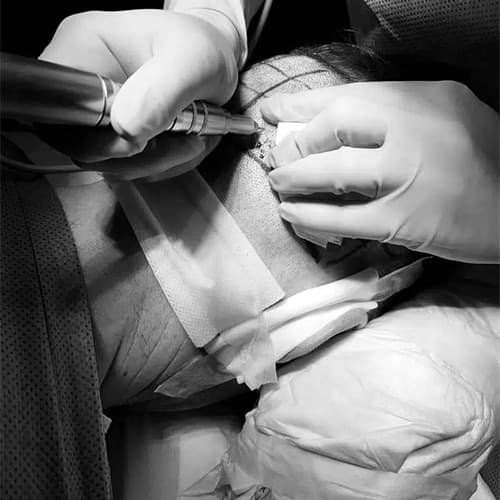
FUE (Follicular Unit Extraction) hair transplant method It is an advanced technique for treating baldness and hair thinning. The hair follicles are taken one by one from the donor area and re-implanted in the bald area. The result – a natural and fuller appearance. Natural, dense hair with no visible scars.
What is a hair transplant using the FUE method?
Hair follicles they are microscopic structures in the scalp that produce the hair and its proper growth. The FUE method… FUE – Follicular Unit Extraction is an advanced hair transplant technique that allows precise and scar-free treatment for certain types of baldness.
The basic principle of the FUE method is to take individual follicular units from a “healthy” area of the scalp — usually the back or sides — and re-implant them in areas affected by alopecia or hair loss.
The procedure requires shaving the donor area and the recipient area beforehand and is especially suitable for patients with localized—not extensive—hair loss.
The method involves a quick recovery, without long incisions or stitches, and has become very popular among both younger and older patients.
When is it recommended to consider an FUE hair transplant?
Not every case of hair loss requires a transplant, and sometimes it is a temporary issue or a nutritional deficiency that can be treated medically.
Conditions such as alopecia areata are not suitable for a hair transplant, since the grafts would be attacked by the immune system. In contrast, when the hair follicles have permanently stopped functioning — mainly due to androgenic alopecia — an FUE transplant can be an effective solution. Androgenic alopecia — a transplant can be considered.
In very advanced cases, the FUT method may be used, but in most cases the preferred choice is the FUE method.. This technique is gentle, leaves no visible scars, and provides a natural and dense long-lasting result.
FUE hair transplant – how it is actually performed
An FUE (Follicular Unit Extraction) hair transplant is considered an advanced, precise technique with minimal discomfort. The procedure is performed under local anesthesia and requires no hospitalization — the patient goes home the very same day.
The process is carried out manually. The donor area is located at the back of the head, and similarly to the implantation area, it is shaved at the beginning of the treatment.
First stage: Collection of follicular units.
For the collection process, a Hybrid Punch® device is used — an innovative technology that enables fast and precise isolation of follicles while preserving their integrity. The main goal is to maintain the stem cells located at the base of the follicle (the bulb) to ensure successful engraftment in the transplanted area.
The physician has full control over the penetration speed thanks to a foot pedal, which allows acceleration or deceleration as needed. The method is based on gentle rotational movements, unlike previous techniques in which the skin was cut by rotation—significantly reducing skin damage and shortening the recovery period.
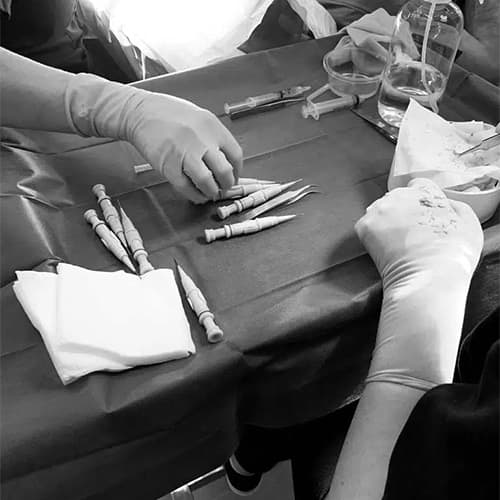
After the follicles are collected, they are preserved in a saline bath and sorted according to the number of hairs in each follicle. Follicles containing one or two hairs are designated for the edges, creating a natural transition between hairy and bare skin areas. The richer follicles (with 3–4 hairs) are implanted in the center to achieve maximum density.
Second stage: Implantation of the follicles in the balding area.
In the past, micro-incisions were required in the recipient area. Today, thanks to the Choi Injector, incisions are no longer necessary—reducing scarring and improving the healing process.
The injector gives the physician precise control over the implantation angle and the desired direction of hair growth, allowing for exceptionally high planting density—about 70 follicles per square centimeter. The result is a highly natural and aesthetically pleasing appearance.
After the implantation: Recovery and follow-up instructions.
Although it is a minimally invasive procedure, the scalp is a sensitive area, and mild pain may occur during the first two days after the treatment—manageable with pain relievers.
Localized swelling is also a common occurrence and usually disappears on its own within about a week.
During the first 48 hours, sleep with your head elevated and avoid contact between the scalp and bedding. It is recommended to avoid any mechanical pressure on the transplanted area.
Recovery is quick: within 2–3 days. Tiny scabs appear and fall off on their own within 10 days.
Gentle washing should be performed starting from the third day, and picking at the scabs must be avoided completely.
As the scabs fall off, some hairs may also shed—but the follicles remain in the scalp, and they will gradually produce new hair over the following months.
After the procedure, it is possible to return to office work the next day, though taking a few days of rest is recommended.
Strenuous physical activity should be avoided for two weeks.
The Clinic IL | The Art of Aesthetic Medicine and Hair Transplants
Before and after hair transplantation – this is what the journey to new hair looks like.
The success of a hair transplant begins with an accurate diagnosis by a specialist physician and selecting the right method for each patient.
Having the procedure performed by an experienced team, combined with advanced technology, leads to natural and impressive results. The first signs of growth appear after about six months, with the final result visible after approximately one year—yielding a full, healthy head of hair over the long term.
How useful was this post?
Click on a star to rate it!
Average rating 0 / 5. Vote count: 0
No votes so far! Be the first to rate this post.